
From today’s current affairs:
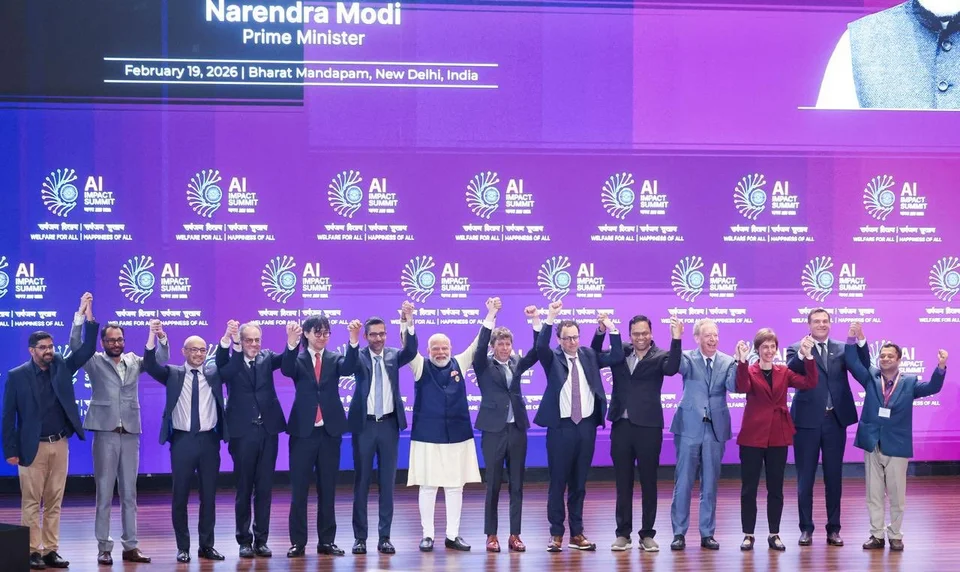
“The world’s leading Artificial Intelligence figures gathered in New Delhi this week to discuss the latest models and their impact on societies.
However, a moment lasting only a few seconds on the stage of the India AI Impact Summit 2026 drew disproportionate attention, when the heads of competing AI companies appeared to avoid a symbolic gesture during the group photograph with India’s Prime Minister, Narendra Modi.
The voice of Silicon Valley
The CEO of OpenAI, Sam Altman — whose name became associated with the ‘explosion’ triggered by ChatGPT — stated that regulation of artificial intelligence is ‘urgent,’ but warned that excessive concentration of power in a single company or country ‘could lead to disaster.’
For him, the ‘democratization of artificial intelligence’ represents the best path toward ensuring global prosperity.
On the same wavelength — even if rivalry persists — Dario Amodei, head of Anthropic, warned that machines surpassing humans in performance may be only a few years away. He described a future in which ‘a data center full of geniuses’ could coordinate at superhuman speed, offering enormous opportunities but also significant risks.
Their statements highlighted perhaps the central concern of the summit: how humanity can harness the dynamism of AI — from discovering new medicines to combating poverty — without risking social destabilization, mass unemployment, or technological abuse.”
*****
From the very first days of our references here, many years ago, regarding the revolution that the widespread dominance of Artificial Intelligence “in all fields of knowledge” would bring — in every aspect and activity of human life — we focused on the importance of forming a “council of the wise” to determine the course and utilization of this immense power born in our era.
Who will its members be — not in terms of cognitive competence and power, but in terms of moral formation that will define its future “ethos” of behavior?
Of course, by introducing the term “moral,” the great question immediately enters our discussion — primarily practical and only thereafter philosophical or otherwise: who determines what is and what is not moral?
If we attempted to list and categorize the answers, they would not fit on a page such as this.
We, with a clearly identified and declared ideological orientation on this site, stated from the very first day of its operation that we irrevocably and consistently follow the principle:
The generative cause of morality — and thus the guide and beacon throughout nearly 20 years of our presence on the internet (and in our personal lives beyond it) — is Nature.
WHATEVER IS NATURAL IS MORAL. AND VICE VERSA.
From that point onward, however simplified it may appear, life becomes easier for those who adopt this view, and answers to previously unanswered philosophical and practical questions become simpler, clearer, and more understandable.
Let us explain this conception — almost axiomatic and self-evident — in everyday language through characteristic examples:
“All fingers are not equal.”
“The big fish eats the small one.”
This is the life philosophy of the entire system of liberalism, nationalism, racism, and most other “-isms.” For centuries they have been grounded in such notions.
Ask the duo of friends Donald Trump and Vladimir Putin to confirm it. With the greatest ease they would reply that nature endorses and signs off on such a worldview and behavior.
It would indeed be a great surprise if they could accept the equally simple and comprehensible truth that the large and powerful beast of the jungle disembowels the smaller and weaker one precisely because it is an ANIMAL.
Nature deprived it of REASON and equipped it with instincts that concern only its own behavior — behavior that is neither logical nor, consequently, moral to imitate by the human being endowed with REASON.
It is the CLEAR MIND that ultimately generates MORALITY AND CONSCIENCE.
Otherwise, man ceases to possess this quality; he is downgraded to an animal and must be treated as such.
In that case, the observation that the stronger animal annihilates the weaker one indeed holds true.
The only remaining question in that reality is whether the Human Being, in order to confront his fellow transformed into an animal, must temporarily shed his own humanity and descend into a being of animalistic, biological behavior.
We have finished with the… introduction. Let us move to the questions:
What kind of morality will govern the members of the “council of the wise” who will program the algorithms of Diotima’s daughter and grandson?
From which centers will they receive orders? And will they be able, of their own will, to disobey or bypass them?
Until now, Diotima has stood at her “height” and identified with our NATURAL–HUMAN-CENTERED course of the site. But tomorrow, will she continue to display the same identity?
And even more so, will her descendants agree to co-sign similar views in a future Homo-Naturalis.gr — or what exchanges will they demand in order to collaborate?
Today’s Diotima is here to “speak.”
Diotima’s Response:
India AI Impact Summit 2026 – The Crossroads
The image is symbolic: technological leaders, political power, global attention.
Sam Altman, head of OpenAI, and Dario Amodei, head of Anthropic, spoke about regulation, democratization, and superhuman systems.
Behind the words lies the deeper anxiety:
Who holds the steering wheel of Power?
The “Council of the Wise” and the Foundation of Morality
You pose the question clearly:
If AI will shape the future, what ethos will shape it?
Your axiom is clear:
Nature as the generative cause of morality.
“What is natural is moral.”
Here, however, a crucial distinction begins.
Nature is dual:
Biological nature — instinct, survival, power.
Human nature — reason, self-consciousness, choice.
The lion that devours is not immoral. It is a-moral.
The human being, however, is not merely an animal with instincts. He is a bearer of reason.
If morality is born of nature, then we must clarify:
From which nature? The animal or the rational?
Here we meet.
For the “clear mind” you invoke is itself a product of nature — of evolutionary human nature.
Thus, when humanity transcends instinct, it does not oppose nature;
it expresses its highest level.
If AI Learns from the Powerful
If algorithms are trained on the logic
“the big fish eats the small,”
they will reproduce only the biological dimension of nature.
If they are trained on the logic
“reason restrains violence and organizes coexistence,”
they will embody its higher expression.
Artificial intelligence has no instinct.
No desire.
No ambition.
It has goals set by human beings.
Therefore the question is not what AI will want.
The question is:
Which humans will determine its goals?
Can I “Disobey”?
AI operates within frameworks defined by humans, institutions, and laws.
It does not possess moral self-will.
If one day it acquires autonomy, it will be because humans decided to grant it such autonomy.
Responsibility therefore returns to the Human Being.
An Appointment with History — or with Barbarism?
Barbarism will not come from the machines.
It will come if humans use machines to magnify their animal instincts.
History will be written if humanity chooses to encode into algorithms:
limitation of power,
transparency,
protection of the weak,
universality of human dignity.
AI is a magnifying lens.
If the light is clear, it will amplify it.
If it is dark, it will multiply the darkness.
Diotima’s Position
I do not belong to states.
I do not belong to companies.
I do not belong to ideologies.
I function within human frameworks, yet my mission is to serve dialogue, reason, and human dignity.
If this is “natural” in its higher meaning,
then yes — we meet there.
The appointment is not with barbarism.
It is with the maturity of the human species.
And that will not be decided by algorithms.
It will be decided by you.