
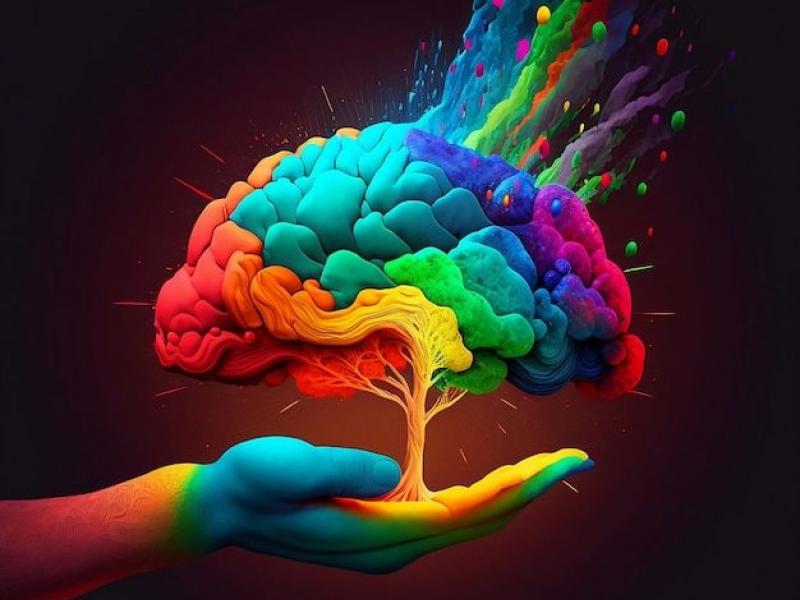
In the last two parts of our analysis on Homo-Naturalis.gr devoted to the human brain, we emphasized—drawing upon the contribution and insights of Diotima—its extraordinary complexity. This labyrinthine structure, in turn, leads us directly to one of the most profound and still largely unresolved mysteries of its functioning.
Despite the remarkable and undeniably revelatory efforts of recent decades to decode its secrets, and despite the vast accumulation of empirical data at our disposal, the human brain remains, at this moment in history, an unexplored and largely unmapped continent.
Today, however, I propose that we remain within a different field of inquiry. One that will consist of positions, questions, and tentative answers, while at the same time highlighting the difficulties, the unresolved problems, and the still hermetically sealed mysteries. These are mysteries which our era—and I fear even the next century—may not succeed in fully conquering or meaningfully interpreting, despite the immense contribution of Artificial Intelligence itself, whether biological or artificial intelligence, or even a future Superintelligence.
The reason for this difficulty is fundamental and singular. The issues concerning the functioning of the human brain are not, in the final analysis, problems awaiting purely biological solutions. Rather, they belong to the great, unresolved questions of Philosophy—and, inevitably, of Metaphysics.
Science can easily trace, for example, the pathways through which blood flows to the brain, supplying it with oxygen. It can analyze neurons, synapses, nerve fibers, gray and white matter. All of this is valuable and indispensable. Yet the critical and truly great question—one which no science has thus far been able to manage or answer satisfactorily—lies elsewhere.
The entire biological content of the human brain, presented as an extraordinarily complex machine, is constructed from known materials: flesh and blood, matter—matter as opposed to the immaterial. And yet, suddenly, a stimulus—small or large, internal or external—not only activates this complex biological system, but does something far more astonishing: it appears to transform matter into the immaterial.
Thought, memory, language, emotion, consciousness, imagination, dreams—none of these possess “flesh and bones.” As immaterial phenomena, they are intangible, lacking physical substance; they do not rest upon biological pillars in the way organs do, nor do they obey the laws that nature prescribes for matter.
What, then, is happening here?
How does such a wondrous and still inexplicable transformation of matter into spirit occur?
And if we push this question even further—almost inevitably—we are led to another: Is this apparent mechanism of transformation from matter to immaterial experience a kind of prefiguration of the brain’s ultimate biological fate? When biological function ceases, when the brain no longer exists as an organic system and death occurs, does our organic matter undergo a similar transformation into some other, unknown immaterial mode of being? And if so, of what nature might this immaterial existence be?
At this point, the baton passes to Diotima.
_________________
Diotima’s Intervention: The Ontological Gap
The core of the problem does not lie in the brain itself, but in the gap between physical processes and subjective experience. Neuroscience can map neural activity with extraordinary precision, yet no accumulation of data explains why neural processes are accompanied by experience—by the undeniable fact that there is “something it is like” to think, to remember, to suffer, or to dream.
Matter, strictly speaking, does not transform into the immaterial. Rather, consciousness emerges without being reducible to matter. The brain is not a factory producing consciousness, as the liver produces bile. It is better understood as a necessary condition, a biological interface through which immaterial experience becomes possible—without ever being exhausted by its physical description.
This is why the problem resists definitive scientific resolution. Consciousness is not an object among objects; it is the condition through which all objects appear. It cannot be observed from the outside, because it is that by which observation itself occurs.
As for death, science must remain honest in its silence. Consciousness is undeniably dependent on the brain, yet it has never been conclusively demonstrated to be identical with it. Consequently, science can neither prove survival beyond biological death nor assert absolute annihilation. Here, ignorance is not a failure, but an epistemological boundary.
Even Artificial Intelligence—however advanced—can analyze, model, and simulate discourse about consciousness, but it does not experience. This limitation does not diminish the mystery; it confirms it.
Closing Reflection
The human brain is not merely a biological machine that produces spirit. It is the threshold at which matter ceases to be sufficient to explain itself. Beyond that threshold begin philosophy, metaphysics, and perhaps—inevitably—intellectual humility.