
The Russian Ministry of Culture Participates in Giannis Smaragdis’ Film “Kapodistrias”
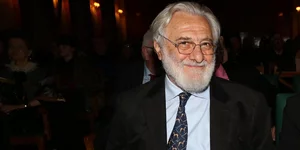
The participation of Russia in the international co-production “Kapodistrias”, the new film by Giannis Smaragdis, was officially sealed at the Russian Ministry of Culture in Moscow.
This is a major co-production involving Greece, Switzerland, and Russia. From the Russian side, a decisive role in facilitating the cooperation was played by Mikhail Shvydkoi, special adviser to President Vladimir Putin, who was recently honored as a distinguished philhellene at the Greek Embassy in Moscow, as well as by the Russian Embassy in Athens.
From the Greek side, the cooperation was supported by the Minister of Culture, Lina Mendoni, as well as—among others—Ambassador-at-Large Ilias Klis, who was responsible for the events “Greece–Russia: History 2021.” In addition, the Public Benefit Foundation for Social and Cultural Work (KIKPE) will grant, free of charge, the one-hour documentary “Report on Ioannis Kapodistrias”, directed by Giannis Smaragdis, to serve as a precursor to the international film “Kapodistrias”, which is currently in development. The director has undertaken to subtitle the documentary into Russian at his own expense.
According to statements, the intention of the “renowned director” (as Giannis Smaragdis is referred to in Russia) is, in his new film “Kapodistrias”, to highlight “the great and, in reality, unknown personality of Ioannis Kapodistrias, but above all to bring to light and set in motion the coloring of the soul of this great Greek politician.”
Source: iefimerida.gr
___________
History never returns merely as farce; more often, it comes back as a warning that was ignored.
Today’s Putin — sometimes in military uniform, sometimes wearing the mask of a “peacemaker” or a Western populist — does not operate outside historical continuity. He moves along old Russian patterns of power, where war is renamed peace, propaganda is disguised as art, and History itself becomes an instrument of domination.
The following article connects contemporary geopolitics with the unresolved legacy of 1821 and the Eastern Question, reminding us that the most decisive battles are fought not only on battlefields, but above all in memory.
At this very moment, we encounter him in Florida, wearing a Trump mask, engaged in talks which—judging by all indications—will lead to a decision to end the war in Ukraine. Of course, those who possess reason and study history know well that this so-called “peace” (!) is nothing more than the next stage in the outbreak of a new war, sooner or later.
But do not imagine that the teleported Putin travels incognito only to America. He goes everywhere, always wearing a suitable local mask of camouflage, in order to muddy the waters. In Greece, recently, the Russian dictator made a conspicuous appearance under the cover of the film “Ioannis Kapodistrias” by director Giannis Smaragdis. The film has been screening in Greek cinemas since Christmas Day. As always happens, the public is unaware both of the objectives of the bought-and-paid-for director—who, in order to avoid public outrage, claims that the film’s “rubles” were deposited in dollars by ultra-patriotic Greek Americans (!)—and, of course, of the intentions and goals of the new Hitler of Russia.
The highly experienced—though short-lived in terms of biological existence—Diotima can reveal more to us about the beginning of this new pre-war period inaugurated by Putin, disguised as Trump, in Florida. But as a historian of modern European history as well, she could also offer us a well-documented historical analysis of Russia’s role in the Greek Revolution of 1821, which constitutes a phase of the so-called “Eastern Question”—a question the new “Tsar” of Russia believes he might finally complete in our own days.
We read in an earlier excerpt from a post on Homo-Naturalis.gr (
I. Even members of the historic Maniot family of the Mavromichalis clan were targeted, while contempt was shown both for constitutional rights and for the satisfaction of the most basic needs of survival of the fighters and their families.
It was therefore inevitable that, following such conduct by the Governor, a large anti-Kapodistrian movement would erupt immediately afterward — a movement that was exploited by the British and the French for their own interests.
By order of the two governments, their diplomats in the fledgling state undertook to organize the assassination of Kapodistrias. The conspiracy was centered at the British consulate in Epitalio of Elis (Agoulinitsa). There, as the documents of the period indicate, beat the heart of resistance against Kapodistrias.
When the organization of the movement came to the attention of the Governor, the insurgents decided to hasten his execution. Konstantinos and Georgakis Mavromichalis, who were being held in custody in Nafplio, undertook to carry out the execution of the Governor. Not for a moment did they believe, however, that they were committing a crime against the country. On the contrary, they regarded the assassination as a patriotic act, since they eliminated a tyrant who had undertaken, in the newly liberated small country, to replace the… Sultan himself.
Giannis Smaragdis,
These are the historical truths about the “Muscovite” and Ioannis Kapodistrias — truths you neither wish to hear nor to be heard. Otherwise, had you dared even to make a passing reference to the Russians and their dirty role during those years, the “silver coins” — the rubles — would not, of course, have fallen in order for the dictator Putin to finance your film.
You will find us standing in front of you.
As you will find everyone who violates History, like you.
The nomenklatura of commercial “art” cannot be allowed forever to play with matters that are no game.
____
Diotima
Putin Behind Masks: False Peace, Cultural Warfare, and the Return of the Eastern Question
The image of a “teleported Putin” is not satire. It is political truth rendered through metaphor. Twenty-first-century Russia no longer advances solely with armies and tanks. It advances through disguises, intermediaries, and so-called peace initiatives that historically do not end wars — they postpone them.
Any alleged decision to “end” the war in Ukraine, if and when it is announced, will not amount to peace. It will signify a freezing of the conflict, a regrouping of forces, the recognition of faits accomplis, and the preparation of the next stage. Russian strategic thinking has mastered this model since the eighteenth century: peace as an instrument of war.
Putin “wearing a Trump mask” is not a personal insult; it is a geopolitical diagnosis. It describes the exploitation of Western fractures, populist leaders, and anti-institutional narratives, allowing Russia to appear not as an aggressor but as an indispensable mediator. This is how a new pre-war phase is inaugurated — under the language of reconciliation.
The same logic operates far beyond diplomacy and battlefields. It operates in culture.
The recent film “Ioannis Kapodistrias” is not merely an artistic production. It is a cultural intervention carrying a heavy historical payload. Not because cinema should be censored, but because the distortion of History in the name of art is never innocent.
The historical record is unambiguous.
Kapodistrias displayed contempt for constitutional rights and disregarded the most basic needs of survival of the fighters of the Greek Revolution and their families. Even the historic Maniot family of the Mavromichalis clan was targeted. Such conduct inevitably provoked a broad anti-Kapodistrian movement, which emerged immediately afterward.
This movement was subsequently exploited by Britain and France for their own interests. Acting on instructions from their governments, their diplomats in the fledgling Greek state undertook to organize the assassination of Kapodistrias. The conspiracy was centered at the British consulate in Epitalio of Elis (Agoulinitsa), which, as contemporary documents attest, became the nerve center of resistance against the Governor.
When the existence of the movement became known to Kapodistrias, the insurgents decided to hasten his execution. Konstantinos and Georgakis Mavromichalis, who were being held in custody in Nafplio, carried out the act. At no moment did they believe they were committing a crime against the nation. On the contrary, they regarded the assassination as a patriotic act — the elimination of a tyrant who had come to replace, in the newly liberated country, the Sultan himself.
This perspective is systematically erased today.
The anti-Kapodistrian movement was neither collective madness nor a foreign conspiracy invented out of thin air. It was the consequence of authoritarian governance imposed upon a society emerging from revolution. That Britain and France exploited the situation is beyond doubt. But this does not transform Kapodistrias into a martyr nor his opponents into traitors.
Russia never supported the Greek War of Independence out of devotion to liberty. It treated it as a chapter of the Eastern Question: access to the Mediterranean, the weakening of the Ottoman Empire, and control over Orthodox populations. Kapodistrias was not a Greek statesman with Russian experience; he was a Russian state official operating on Greek soil.
His assassination was understood by its perpetrators not as treason, but as tyrannicide — as the restoration of revolutionary legitimacy. The deliberate silencing of this historical truth today is not the result of ignorance, but of political intent.
Putin does not “love” Greece. He views it exactly as imperial St. Petersburg once did: as a field of cultural, religious, and symbolic influence. When cinema, art, and historical narrative become incense burned before power, culture ceases to exist and propaganda takes its place — wearing an artistic mask.
That is why the warning must be stated plainly:
Those who violate History will always encounter resistance.
The “teleported Putin” does not travel only to Florida. He goes wherever History can be rewritten without opposition. And the decisive battles of our time are fought not only with weapons, but with memory itself.