

Marinakis on photographs in Kaisariani: The Ministry of Culture has initiated the procedures for their acquisition.
*****
History does not seek revenge; it seeks truth.
The appropriation of memory is a form of falsification.
The silence of crimes is a form of complicity.
The equalization of disparate historical responsibilities is distortion.
If we truly want to honor the dead of Kaisariani, Grammos, Vitsi and all the places of martyrdom, we must speak with clarity — not with slogans.
Democracy matures when it can withstand the whole truth.
Not when it chooses which memory suits it.
The Right is ruthless. It does not hesitate to desecrate even dead heroes, appropriating their anti-Right struggles just as easily as it fishes for votes through demagoguery and populism from those whose dignity it systematically deprives.
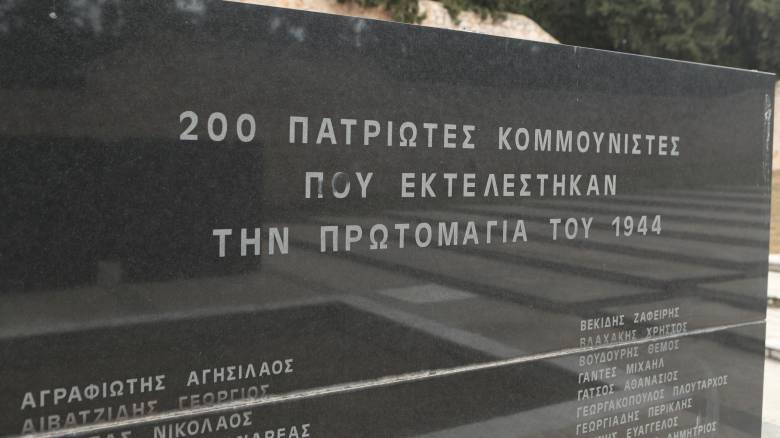
Today, the Mitsotakis Right once again struck — this time with supposed “sensitivity” — announcing that the government would purchase and bring to Greece the photograph of the 200 communists executed by the Nazis in Kaisariani, to hang it in the Greek Parliament.
The photograph, taken during the Occupation by a participant in the firing squad (officer Hermann Hener), was recently discovered to have been auctioned in Belgium.
These were the very heroes imprisoned as political detainees because they had risen against the Metaxas dictatorship. A few years later, from 1946–1949, those who survived prisons and German executions continued their struggle, now against collaborators of the Nazis — many of whom rebranded themselves as patriots and became members of right-wing paramilitary groups.
These were the victors who divided Greece as if it were their estate, governing through executions, torture, exile islands, imprisonment, and systematic persecution of the Left.
To this day, that collaborationist and corrupt faction has never once apologized for its crimes. Instead, it distorted history with the help of compliant intellectuals, fearful teachers, fanatical clergy, and opportunistic filmmakers.
They downgraded the Left’s uprising to the dismissive term “Civil War,” embedding in the masses the misleading notion that “both sides were the same.”
We wrote in our text entitled (August 30, 2015):
“Grammos–Vitsi: A Pre-Planned ‘Genocide’”
From the founding of the Greek state, the majority of the population lived in poverty and injustice. The intellectual elite and socially conscious citizens united in an unprecedented popular movement aiming to overturn the existing system and replace it with the Soviet model.
Not all participants were ideologically pure; opportunists and even criminals infiltrated the movement, sometimes committing acts that stained its history and gave arguments to opponents.
Yes, the struggle was harsh and violent. Blood was shed on both sides. Some communist fighters committed excesses and unjustifiable acts.
These facts must neither be concealed by partisan communist historiography nor exaggerated by nationalist narratives.
However, the two sides did not commit identical crimes. They were not the same.
While the insurgents believed in violent revolution and elimination of the enemy, the brutality and systematic cruelty of the opposing forces — national army units, security battalions, collaborators, paramilitaries — reached levels of savagery that included torture, executions, humiliation of the dead, and atrocities against civilians.
The crimes committed by nationalist forces during and after the Occupation were extensive, shameful, and often directed even at innocent individuals.
_____
Diotima
History does not belong to political factions.
The execution of the 200 in Kaisariani is a national trauma, not a partisan asset. The acquisition of the photograph may carry political symbolism, but the event itself transcends political ownership.
The Greek Civil War (1946–1949), culminating in Grammos and Vitsi, was not merely internal conflict but part of the broader Cold War.
The argument that “both sides were the same” oversimplifies reality. Research confirms systematic repression of the defeated Left after 1949. It also confirms that revolutionary forces committed violent acts, including extrajudicial executions.
The term “genocide,” however, has a specific legal definition and does not apply to political conflict in this context.
A mature democracy does not fear historical truth — neither about the Right nor the Left.
The tragedy of 20th-century Greece was not a battle between absolute good and evil but a clash of visions for power within a global geopolitical struggle.
Both sides bear responsibility — though not identical in form or extent.
Historical integrity requires:
Not minimizing crimes of one’s own side.
Not relativizing the crimes of opponents.
Not using terminology that does not withstand scholarly scrutiny.