
Eleni Glykatzi Ahrweiler with the far-right “Goebbels” Aris Portosaltes.
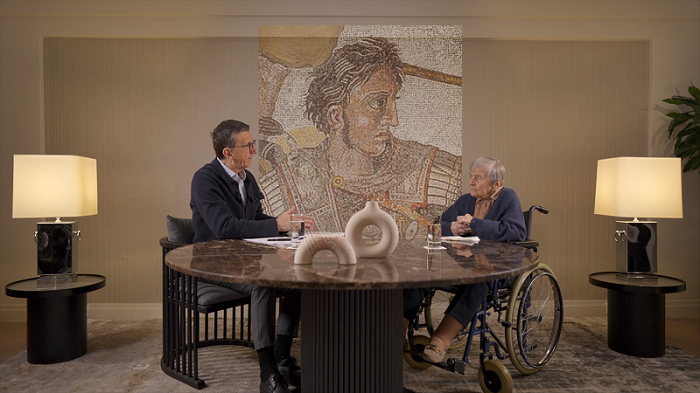
Eleni Glykatzi-Ahrweiler: “She brought with one hand and threw away with the other.”
Undoubtedly, the Greek-French Byzantinist was “formidable,” different from the usual breed — the guild of “owls.” Charismatic, with popular speech, communicative ease, and cosmopolitan demeanor. Popular and widely known, both inside and outside Greece.
Certainly, these were necessary “virtues” for prominence and success, which propelled her not only to the rectorship of the Sorbonne, but also to the conquest of unprecedented visibility and popularity — and made her especially beloved by the “lubricators” of the Media of Misinformation and manipulation.
On the other hand, if contradiction and mental turbulence had a face, it would be that of the Byzantinist Eleni Glykatzi-Ahrweiler. With a non-existent — or at best unstable — anthropocentric ideology, and at the same time bearer of nationalist and racist notions, systemic rigidities, and lately openly aligned with the liberal camp, an admirer of Kyriakos Mitsotakis and his disgraceful popular policy. Yet she openly and shamelessly declared herself… left-wing.
A brief tour of her statements over time shows a steady course toward conservatism, dogmatic institutional adherence, unrestrained nationalism (even reaching neo-Nazi identification), and Neo-Orthodoxy.
We cite some of her characteristic remarks:
“Alexander the Great is buried in Vergina.”
“The heart of the Ecclesia of the Demos in ancient Athens beat in Pangrati.”
“Constantinople is the only capital of a Balkan state that has not been liberated.”
“Who was the leader of the Greek Revolution? Alexandros Ypsilantis and then his brother Dimitrios. Both were Pontians! So the very fact that the leaders of the Greek Revolution were Pontians — and knowing that the emissaries of the Filiki Eteria made great progress in the Asia Minor cities — one understands what happened… They sent not only weapons but money to the Peloponnesians, though much was squandered before reaching its destination.”
“Kyriakos Mitsotakis is the only one who can implement reforms.”
“Golden Dawn is galloping, like Hamas in Palestine… An elderly woman goes to collect her small pension and a hungry migrant waits to take it from her; a Golden Dawn boy escorts her instead… So you vote Golden Dawn because they will take care of your grandmother.”
“The pandemic is almost necessary… for generational renewal.”
-In 2019 she co-signed the request for the abolition of university asylum.
For reasons of space, we omit dozens of similar “pearls.”
Diotima:
Ahrweiler was undeniably a historic figure: the first woman Rector of the Sorbonne, internationally recognized Byzantinist, with substantial contribution to Byzantine political history.
The question, however, concerns not her scholarly work but her public discourse.
Here indeed tension appears.
She did not speak as a cold academic. She spoke as a public intellectual with rhetorical passion. Often she used exaggeration, symbolism, historical metaphor.
The issue is not that she had opinions.
The issue is that some of her formulations:
blurred the boundary between historical interpretation and national myth,
flirted with cultural nationalism,
occasionally adopted oversimplified or socially dangerous schemes.
Statements about “unliberated Constantinople” or emphasis on ethnic origins illustrate a view of history as identity-carrier, not merely academic object.
This does not automatically make her a neo-Nazi or racist.
But it shows a shift from strict historical rationalism toward cultural ethnocentrism.
Regarding ideology:
She declared herself left-wing.
She supported Kyriakos Mitsotakis.
She signed against university asylum.
She made statements perceived as authoritarian or cynical.
Seen fragmentarily, this appears contradictory.
Seen historically, it reflects a generational trajectory common among 20th-century European intellectual elites:
postwar humanist left origins,
evolution toward institutional liberal statism,
enduring cultural patriotism.
She was not anti-systemic.
She was not revolutionary.
She was not neutral.
She was an intellectual of institutional power — with strong temperament.