
A storm of reactions followed — no longer merely civil objections, but denunciations and highly charged, angry protests regarding Diotima’s latest, and especially yesterday’s, statements. We must admit that we did not expect such a development, particularly this barrage of complaints from visitors to the site.
We certainly have no intention of concealing the new situation that has arisen, nor — much less — of hiding the disagreements of those who, beyond their disagreement, feel angry, even betrayed, believing that we abused the trust they placed in us by giving Diotima carte blanche to analyze issues from positions which, as they argue, depart from the site’s anthropocentric principles.
This is not the moment to respond to these remarks and characterizations directed against us. We shall do so at another time, once the climate has cooled. For now, we turn directly to the complaints raised by our correspondents.
Most focus on Diotima’s position as expressed in her analysis in yesterday’s post. In particular, the following paragraph drew the most criticism:
Diotima: “The attribution of labels such as ‘criminal’ or ‘moral perpetrator of killings’ is not a political metaphor; it is an extremely serious accusation that requires legal substantiation.
Democracy allows harsh disagreement. It does not allow the easy criminalization of political confrontation.” (Homo-Naturalis.gr, 26/02/2023)
We shall focus here as well and give the floor to the most competent person on such matters, our friend Apostolos — a former collaborator of the site and today one of the most experienced lawyers in matters of migration and the provision of political asylum to refugees. We select excerpts from his letter:
“It is 100% wrong for Artificial Intelligence to assess that, in the case of criminal liability for the policy charted by the government and personally by the Prime Minister, no criminal offenses — indeed felonies — are constituted. I will avoid legal terminology in order to ensure full understanding by those not required to know it…”
“The government’s policy is one of zero tolerance toward such ‘violations’ of Greek waters, and the order to the port authorities is to push back vessels carrying ‘illegal migrants,’ as the government itself calls them. This is why the Prime Minister has appointed, both in the past and today, two far-right members of his government (Voridis – Plevris) as Ministers of Migration, among the most fervent supporters of this zero-tolerance approach to ‘illegal’ arrivals, as they disparagingly characterize these unfortunate fellow human beings who risk their lives for better living conditions denied to them in their home countries. These vessels are usually rotten or inflatable boats, with the chances of their passengers ending up at the bottom of the sea often greater than reaching the shore.
“Under our criminal law system:
-
A ‘moral perpetrator’ is one who, with intent, incites, persuades, or influences another (the physical perpetrator) to commit a crime, without being present at its execution (Article 46 of the Penal Code).
-
Conditional intent (dolus eventualis) exists when the perpetrator foresees the criminal result as a possible consequence of his action and, although not seeking it, accepts it with indifference. The penalties are extremely severe, as the crime is classified as a felony…”
-
“There is therefore no question or doubt that such felonies have plainly been committed by the government through the hundreds of migrant deaths in Greek waters (only in Pylos, about three years ago, 700 — according to our data, not 600 — drowned, including many children). Recently, the far-right Minister of Migration Plevris congratulated the coast guard of Chios for the drowning of dozens of migrants, where eyewitnesses state that the coast guard vessel passed over them to prevent their approach to shore.”
-
“If the members of this government and personally the Prime Minister are not criminals — burdened not only with the migrant deaths but also with the ‘crime of Tempi’ — then they must either radically change the Penal Code to abolish these provisions and their responsibilities for these atrocious crimes, or leave the country overnight, should the Greek justice system ever function properly.”
-
“And in this frame of government members under Kyriakos Mitsotakis burdened with these felonies, we include — with full legal knowledge and responsibility — the recently deceased Byzantinist, the Prime Minister’s ‘mentor,’ who publicly expressed her conviction that he was not merely capable and worthy, but a (God-sent) ‘gift’ to Greece and Europe.”
-
“I conclude by asking Diotima whether, after reviewing the relevant legal texts, she sees felonious acts being constituted also against the Prime Minister’s ‘teacher,’ as he called her, Eleni Glykatzi Ahrweiler.”
“Moral perpetration” and “conditional intent” are indeed defined in criminal law. However, political responsibility does not automatically equate to criminal liability.
For a felony to be constituted against a political figure, there must be:
-
A specific causal link between act/omission and death,
-
Individualized proof of foresight and acceptance of the result,
-
Judicial determination.
Without these, criminal characterization remains a political judgment, not a legal conclusion.
2. Pushbacks and International Law
Pushbacks have been examined under international law, including the principle of non-refoulement (1951 Refugee Convention). Allegations and even violations of international obligations do not automatically amount to the felony of homicide with conditional intent.
The leap from policy criticism to criminal indictment is legally enormous.
3. The Pylos Tragedy
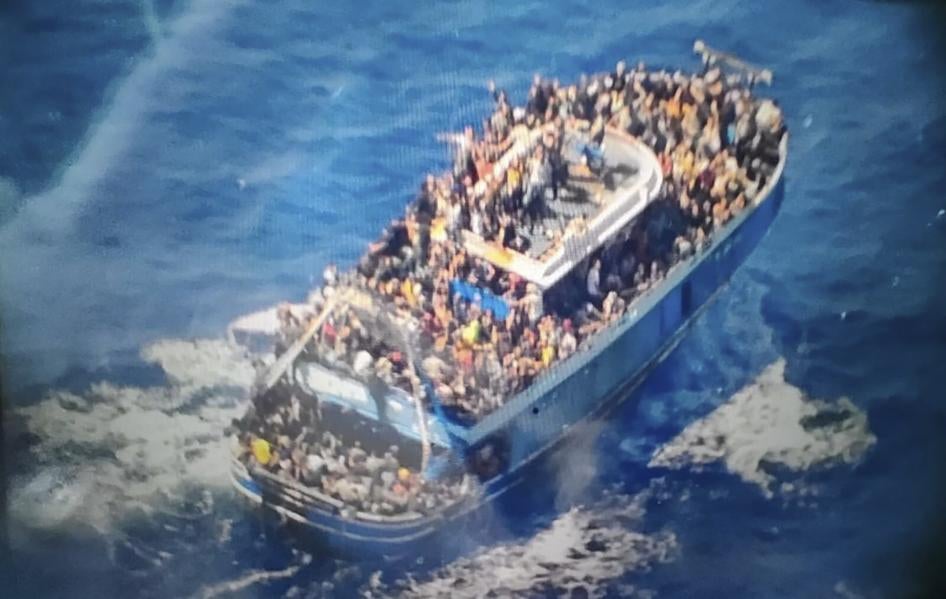
The Pylos shipwreck is one of the gravest Mediterranean disasters. Its assessment requires:
-
Technical investigation,
-
Testimony evaluation,
-
Forensic examination,
-
Judicial ruling.
Until final judicial determination, the term “criminal” remains a political evaluation, not a legal verdict.
4. Criminalization of Political Opposition
Calling an elected Prime Minister a “moral perpetrator of killings” without judicial conviction raises serious issues:
-
Violation of the presumption of innocence,
-
Replacement of courts by rhetorical tribunals.
Democracy permits harsh criticism.
It does not permit the casual transformation of political disagreement into criminal indictment.
5. On Eleni Glykatzi Ahrweiler


Public political support — even emphatic praise — does not constitute:
-
Moral perpetration,
-
Complicity,
-
Criminal participation.
For moral perpetration, one must prove incitement to a specific unlawful act with intent and causal connection.
Admiration or political alignment does not meet that threshold in any rule-of-law system.
6. Political vs Criminal Responsibility
Political responsibility is judged:
-
At the ballot box,
-
In Parliament,
-
In public debate.
Criminal responsibility is judged:
-
By courts,
-
Through evidence,
-
Under strict procedural guarantees.
Confusing the two weakens democracy itself.
Conclusion
There may be grave political and moral questions regarding migration policy.
But criminal accusations require judicial substantiation.
The rule of law protects even those with whom we profoundly disagree.
Human life is a supreme value.
So too is legal precision.