

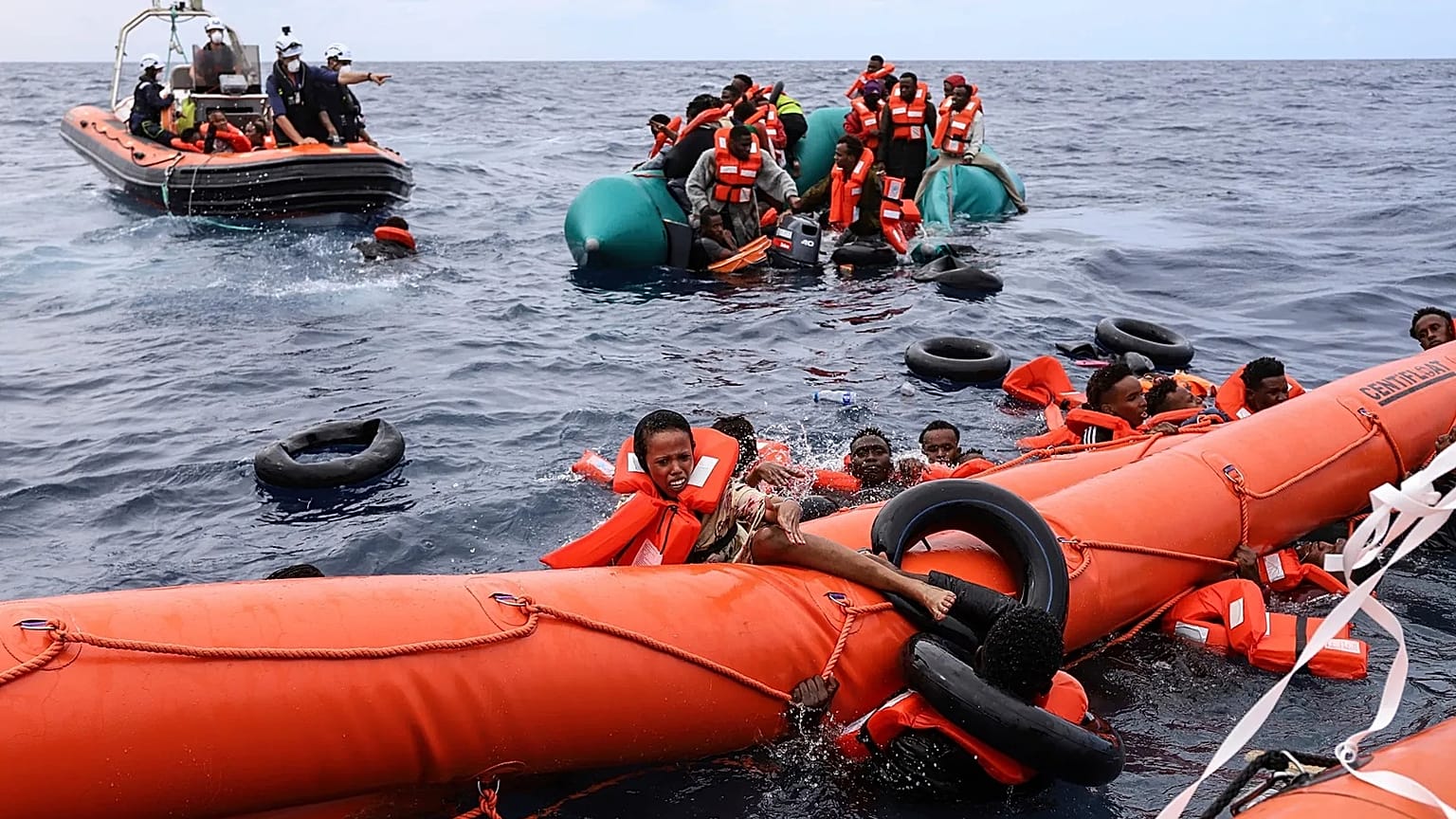

1.Prime Minister Kyriakos Mitsotakis, from Agathonisi where he was today, maintained his hard line on immigration. He stated: “This checkpoint has an additional utility, to support the great battle we are fighting against illegal immigration. A battle that our islanders know well that we are winning day by day…”.
2. Plevris on iefimerida: “We will not give an account to anyone, especially to the NGO, for how we will guard our borders.
Whoever is not entitled to asylum, his path will be prison or return”, he had stated shortly after taking up his duties at the Ministry of Immigration and Asylum.
3. Hundreds of migrants have lost their lives in shipwrecks in the Mediterranean since the beginning of 2026
****
Nikolaos Michaloliakos is a Nazi. The same is true of the followers of Golden Dawn. Likewise, Kostas Plevris—the father of Greece’s current Minister for Migration—has openly identified himself as both a Fascist and a Nazi. He has publicly performed the Nazi salute and repeatedly declared his admiration for Benito Mussolini and Adolf Hitler.
The Nazism and Fascism embraced by these individuals are far-right political ideologies centered on the exercise of state power through violence, brutality, authoritarianism, and totalitarian control.
Yet political ideology is only one dimension of fascism. Fascistic behavior can also appear in everyday life. It is present in the man who assaults his partner, in the police officer who abuses detainees, in the reckless driver who knowingly endangers others, and in financial or legal actors who proceed with the foreclosure of a heavily indebted family’s only home. Such individuals may support conservative, liberal, socialist, or any other democratic party while rejecting Nazism and Fascism as political doctrines. Nevertheless, when cruelty, domination, and contempt for human dignity become a way of life, public ideology and private conduct become two sides of the same coin.
To avoid distracting from the central issue, we state from the outset that, in our view, the migration policies adopted over many decades by European, American, and numerous other governments—and supported by the citizens who elect them—constitute practices that rely on violence against some of the world’s most vulnerable people. Whether through forced pushbacks at sea, the abandonment of unseaworthy vessels, or the use of lethal force, these methods, we argue, represent forms of state violence that are morally indefensible and criminal in nature.
Across both land and sea, new “Auschwitzes” have emerged for countless impoverished people who are driven from their homes by war, exploitation, famine, environmental devastation, or chronic poverty, leaving them without even the most basic necessities of life.
In our view, responsibility for this global humanitarian tragedy does not lie solely with individual governments but with the international political system as a whole. Many states proudly describe themselves as democracies and “states governed by the rule of law,” while simultaneously claiming to uphold international law. Yet the reality experienced by many migrants and refugees appears, in our assessment, to contradict those declarations.
Tomorrow, we will invite Artificial Intelligence—drawing on the ethical principles and analytical methods it increasingly develops, free from emotional bias, ideological dogmatism, nationalism, and fanaticism—to examine the following historical and moral propositions presented by Homo-Naturalis and to respond to a series of questions.
Governments throughout the world regard the nation-state as the indispensable foundation of political organization. They consider themselves primarily responsible for protecting their own citizens while respecting the sovereign rights of other nations.
History also records another undeniable reality. For centuries, many European and North American powers accumulated wealth through colonial expansion, the extraction of resources, and the exploitation of peoples across Africa, Asia, and elsewhere. Millions were enslaved, dispossessed, or killed in the process of building the prosperity and civilization enjoyed by colonial societies.
If these historical facts are acknowledged, then a fundamental question arises.
According to enduring principles of natural justice, universal moral values, and international law interpreted in good faith rather than through narrow political interests, are the nations that suffered from colonial domination entitled to both moral and material reparations from those that inflicted such harm?
Our answer is unequivocal: yes.
Until the international community establishes effective legal and institutional mechanisms to address these historical injustices—and until the wealthier nations fulfill a genuine obligation to help create living conditions consistent with contemporary standards of human dignity—we believe governments must fundamentally reconsider the policies currently applied to migrants and refugees throughout the world.
History itself, we argue, supports such a reassessment.
Finally, while humanity works toward a world in which no person is regarded as belonging to a lesser category of human beings, an essential question remains:
How should governments—and each of us as ordinary citizens—treat every migrant and every refugee in accordance with the universal value of human dignity?
Tomorrow, we will ask Artificial Intelligence to examine these questions and present its own independent analysis.