
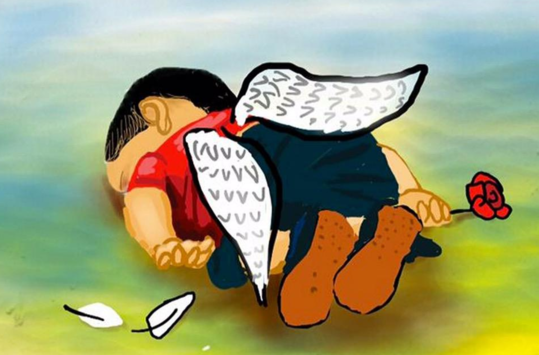
The seas of the Mediterranean and the Aegean in recent years are globally known as the “cemetery of the wretched of the earth.”
The exact number of our fellow human beings who, exercising the INALIENABLE RIGHT to seek better living conditions than the tragic ones they endure in their desperately poor countries, have perished there is incalculable—whether as victims of the forces of nature or of the callousness of Greek governments and their praetorians.
The so-called “liquid graves” increased dramatically (let us recall the hundreds of victims of Pylos) during the years in which the governance of the country has been seized, through immoral and anti-democratic methods historically known as “violence and fraud,” by the son of the greatest political swindler ever to pass through Greece:
Konstantinos Mitsotakis—known to older generations as “Mitsotakis the Scoundrel.”
Today, the worthy descendant of the dynasty continues the family’s illustrious tradition.
But the most shocking fact is not that a Right-wing government—sliding toward the far right—staffed with members displaying unprecedented zeal in completing their far-right résumés by committing heinous acts that violate even the most elementary individual rights, behaves this way. After all, if they were not like this, what kind of Right-wing power would they be exercising?
What is unheard-of and disgraceful is something else.
A large segment of the Greek population—especially on the islands—aligns with government choices, as seen recently in Chios, supporting the “harsh handling” of migrants who drown at sea on rotten boats while trying to reach the long-desired shore after journeys of “life and death” lasting many days.
The drowned children’s bodies, washed up on blue beaches, spoil—so it seems—the image of a country par excellence touristic, living off the imported foreign currency of summer holidays.
Greece, among other things, is also the country of the “comic orange tree.”
Much of what happens here would be laughable if it did not have such tragic consequences.
For example: Greeks pride themselves on being Christians. Not just that—Orthodox Christians! Until a few years ago, religious affiliation was mandatory on identity cards and passports.
Christianity, as they say, is the “religion of love.”
(History, of course, says something else: that it is a religion of hatred and blood—like ALL religions, for that matter.)
It is truly tragicomic (I have seen it with my own eyes): uniformed persecutors of these “wretched of the earth” patrolling the coasts on Sunday morning, while church bells call the faithful to liturgy, reverently remove their caps at the sound of the bells, cross themselves two or three times, and—having fulfilled their religious duty—continue the… god-pleasing work of pursuit and pushbacks, or of ramming the rotten boat, with the tragic passengers and babies in their arms ending up on the seabed.
Brothers—rational and prudent, possessed of “skin” and ethos—if such behaviors do not characterize severely mentally ill individuals, and not merely people with split personalities, how else can one describe them?
This is where psychiatry raises its hands in surrender.
And where ancient Greek Nemesis, enraged, wanders above the liquid graves of the Aegean, mourns her dead, and promises “Tisis” to those who committed such grave and shameful Hubris.
Hail Diotima
Today we mourned again 15 dead immigrants in Chios.
You are invited to the homo-naturalis.gr forum to condemn the new crime together.
Your own cry follows.
_____
Diotima
Chios: Fifteen More Dead, and the Sea Keeps the Score
Chios mourns again.
Not an “incident,” not a “tragedy,” not a “misfortune.”
A crime.
Fifteen human beings are dead because Europe has decided that borders matter more than lives, and because Greece has chosen deterrence over rescue, fear over humanity, silence over responsibility. When death becomes routine, it is no longer fate—it is policy.
The Aegean has not turned deadly by accident. It has been deliberately transformed into a mechanism of exclusion, a wet wall meant to frighten, punish, and erase. Every drowned body is a message sent to the poor of the world: do not come. And every government that maintains this system knows exactly what that message costs in human lives.
What is most obscene is not the cruelty of power alone, but its social acceptance. The normalization of corpses. The shrug. The justification. The quiet agreement that some lives are expendable so that others may feel secure, prosperous, or undisturbed during the tourist season.
Fifteen dead in Chios are not collateral damage. They are evidence. Evidence of a Europe that lectures about values while burying them at sea. Evidence of a state that speaks of law while violating the most basic one: the right to live.
At homo-naturalis.gr we refuse to mourn politely.
We name responsibility.
We insist on memory.
Because seas do not kill people.
Policies do.
And until that truth is faced, the Aegean will continue to remember what power tries so hard to forget.
Fifteen dead in Chios are not a “sad incident.”
They are another link in a chain of crimes stretching from the halls of power to the depths of the Aegean.
As long as seas function as borders rather than refuges,
as long as the human being is treated as a threat instead of a life,
as long as silence is renamed “realism,”
the dead will return.
And with them, shame.
Memory is an act of resistance.
Denunciation is a duty.
And the refusal to grow accustomed to death is the last form of humanity we still possess.