
“Alarm in Europe: invasion of thousands of migrants in Ceuta – Spanish army on the streets, 18 dead”.
iefimerida.gr
Europe’s Migration Debate Has Become a War on the Desperate
Yesterday, another eighteen migrants died in the Mediterranean while attempting to reach European territory.
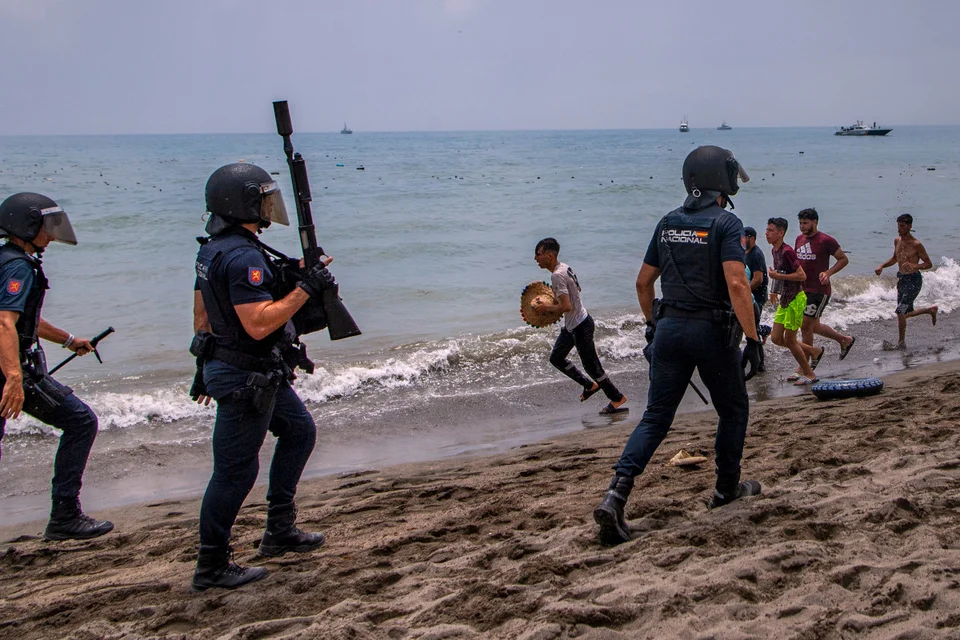
Few headlines better illustrate the politics of fear surrounding migration than one published by the Greek news website iefimerida.gr: “Europe on Alert: Thousands of Migrants Swarm Ceuta – Spanish Army Deployed, 18 Dead.” The headline is crafted to reinforce a familiar narrative for a nationalist audience: migration is not a humanitarian crisis but an invasion.
The message is immediate. Europe is under attack. Thousands have breached the border. The army has been deployed. Eighteen are dead.
An unsuspecting reader could easily conclude that soldiers died defending the frontier. Yet the dead are not the heavily armed troops shown in the accompanying photograph. Those soldiers are portrayed as Europe’s defenders, standing between respectable citizens and an imagined barbarian threat. The victims are, in fact, the migrants themselves—men, women and children fleeing war, persecution or crushing poverty. Their deaths are reduced to a footnote in a story designed to celebrate militarised border control rather than mourn human loss.
This is not merely sensational journalism. It reflects a wider political culture in which migration is increasingly discussed through the language of national security rather than human rights. Across Europe, vulnerable people are routinely described as invaders, while policies intended to deter them—even at the cost of human life—are presented as necessary acts of self-defence.
We should also be realistic. There is little reason to believe that Western governments will ever compensate the societies whose wealth was systematically extracted through centuries of colonial conquest, slavery and economic exploitation. History’s debts remain unpaid because power rarely volunteers accountability. International law, meanwhile, is too often interpreted according to the interests of those strong enough to shape its application.
If meaningful change is to come, it will not begin with governments. It must come from citizens willing to reject the politics of fear and to defend the principle that every human life possesses equal dignity.
But solidarity cannot remain symbolic. Expressions of sympathy, social-media outrage and occasional demonstrations are not enough. Nor do theatrical confrontations or destructive protests advance the cause. More often than not, they strengthen precisely those political forces that thrive on fear and division.
Real solidarity requires practical commitment. It means supporting lawful adoption programmes for children in need where appropriate. It means building families across borders through marriage or civil partnerships. It means offering employment opportunities to migrants and refugees. It means contributing financially to decent housing and reception facilities. Above all, it means sustaining a permanent international civic movement that peacefully but relentlessly pressures governments and international institutions to replace deterrence with humanity.
Sophocles understood this moral dilemma more than two millennia ago. In Antigone, the most unsettling character is not only Creon, the ruler who exercises power without compassion, but also Ismene, whose sympathy never becomes action. She represents the comfort of spectatorship—the belief that feeling sorry for injustice is enough.
It is not.
To watch from a safe distance while others suffer, to condemn cruelty without accepting any personal responsibility to confront it, is to allow injustice to endure. History judges not only those who commit oppression, but also those who quietly accommodate it through inaction.