
“Yesterday, at Ritsona, family, friends and colleagues gathered to bid a final farewell to the actor Nikos Kalogeropoulos.
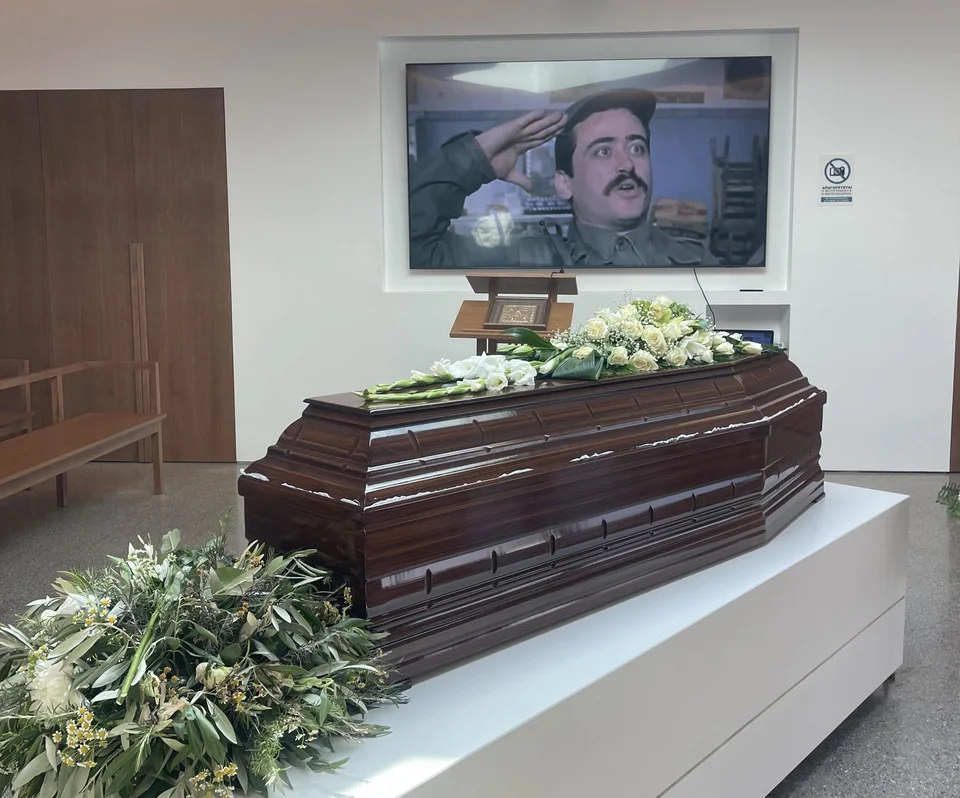
To the sound of “Ston Teke tou Kato Kosmou” (“At the Underworld’s Hash Den”), a song for which Kalogeropoulos himself wrote both the lyrics and the music, his children, his sister, close relatives, friends and fellow actors said their final goodbye at the crematorium.
At the same time, relatives, friends and a large crowd gathered at the Church of Saint Panteleimon in Chalandri to bid farewell to the distinguished writer Stelios Ramfos. The funeral was held at public expense”.
________
Two funerals. Two public figures. Two very different ways of saying farewell.
And somewhere between these two events, Sophocles’ Antigone suddenly becomes remarkably contemporary.
ANTIGONE, SOPHOCLES — Lines 18–30
ANTIGONE:
I knew it well, and that is why I sent you
outside the courtyard gates, so that you alone might hear.
ISMENE:
What is it? You clearly have something troubling to tell me.
ANTIGONE:
Is it not that Creon has granted one of our two brothers
the honour of burial, while denying it to the other?
They say that Eteocles, having acted justly
and according to the law,
he has buried beneath the earth,
honoured among the dead below;
but Polyneices, who died miserably,
they proclaim throughout the city
must remain unburied—
no one may cover him with earth,
no one may mourn him,
but he must be left without tears, without burial,
a sweet treasure for the birds
to feast upon.
Antigone informs her sister Ismene of Creon’s decree: Eteocles is to be honoured as a hero who died defending his homeland, while Polyneices, who fought against Thebes, is to be left unburied, exposed as prey to the birds.
More than two thousand years later, the political vocabulary has changed. The political mechanism, perhaps, has not.
In twenty-first-century Greece, the Prime Minister gives the order for the distinguished writer Stelios Ramfos—an intellectual associated by many with the country’s neo-Orthodox current and with views sympathetic to the governing political establishment—to be honoured with a state funeral, that is, to be buried at public expense.
The actor Nikos Kalogeropoulos, by contrast, who during his lifetime was not known for any particular affinity with organised religion or with the political right, did not receive that same “highest honour.”
One might object: Kyriakos Mitsotakis is neither Creon nor a king or tyrant. He is the elected Prime Minister of a democratic country.
And that is true.
We are no longer living in the Thebes of antiquity. Power is not handed down by divine right or hereditary succession. It is conferred through the ballot box and the popular mandate of democratic elections.
And yet history insists on reminding us of something uncomfortable: ideas, concepts and political attitudes often change their language without necessarily changing their underlying substance.
An old piece of furniture can be polished, varnished and made to look new. But the material from which it was made remains the same. And sometimes, with age, the wood becomes rotten—worm-eaten and fragile beneath the fresh coat of paint.
This is precisely the paradox:
“Everything around us changes, and everything remains the same.”
The words change. The political vocabulary changes. The ideological packaging changes. But the underlying logic—the cellular structure, so to speak—can remain remarkably familiar.
In Sophocles, the enemy of the homeland is Polyneices.
But what, in reality, is “the homeland” in Creon’s political reasoning?
It is difficult not to see that, beneath the rhetoric of the city and its laws, there is also the question of who controls the throne.
Today, the same mechanism can take another form.
Those who are friendly to the government can easily become identified with patriotism, responsibility and the national interest. Those who oppose it can, by contrast, be labelled unpatriotic, extreme, hostile or even anti-Greek.
From that point onward, the interpretation of reality depends largely on where one is standing.
On one’s point of view.
On the breadth of one’s field of vision.
And, perhaps most importantly, on how clearly one is capable of seeing.
The labels we attach to people—the classifications, the divisions, the separation between “our people” and “the others”—have been among the most persistent causes of conflict throughout human history.
Yet the criterion used to divide them often remains remarkably constant:
Who serves my interests?
And then comes the second step: persuading the other person that your interests are also theirs.
That your ideas are their ideas.
That your cause is their cause.
That your enemy is their enemy.
This is where propaganda enters the picture.
There is perhaps no more enduring instrument for binding people together around an ideology than the transformation of my truth into Truth itself.
The twentieth century demonstrated the terrifying effectiveness of this mechanism with particular clarity. Joseph Goebbels understood the power of propaganda: repetition, emotional simplification, the construction of an enemy, and above all the presentation of a particular political interpretation as though it were the only possible reality.
But the mechanism itself is much older than the twentieth century.
Even religious discourse has not escaped the temptation to divide the world into those who belong and those who do not. The Gospel itself contains the stark formulation:
“Whoever is not with me is against me, and whoever does not gather with me scatters.”
Matthew 12:30; Luke 11:23.
The point is not to equate the Gospel with Goebbels, nor Christianity with political propaganda. The point is to recognise a recurring human mechanism: the creation of an absolute boundary between “us” and “them.”
Once that boundary has been established, the rest becomes easier.
The friend becomes virtuous.
The enemy becomes suspect.
The loyal citizen becomes a patriot.
The dissenter becomes dangerous.
One person is worthy of honour.
Another is worthy of silence.
One body is buried with ceremony.
Another is left symbolically—or literally—unburied.
This is the enduring lesson of Antigone.
The tragedy is not merely about burial.
It is about who has the authority to decide who deserves to be honoured and who deserves to be erased.
Creon believes that he is defending the city.
The question Sophocles leaves us with is whether the city is still being defended when the ruler’s definition of “the city” becomes indistinguishable from his own definition of loyalty.
And that is why Sophocles remains so disturbingly contemporary.
The names change.
The institutions change.
The constitutions change.
The political parties change.
The language changes.
But the temptation of power remains remarkably constant:
to turn one’s own definition of the good into the definition of the good itself—and to regard those who disagree not merely as opponents, but as enemies of the common world.
Perhaps that is the real lesson hidden beneath the two funerals.
Not who deserved a state funeral.
But who gets to decide who deserves one.