
The new General Secretary of New Democracy, Konstantinos Kyranakis: “The battle ahead is not merely an electoral one, but a battle of ideas.”
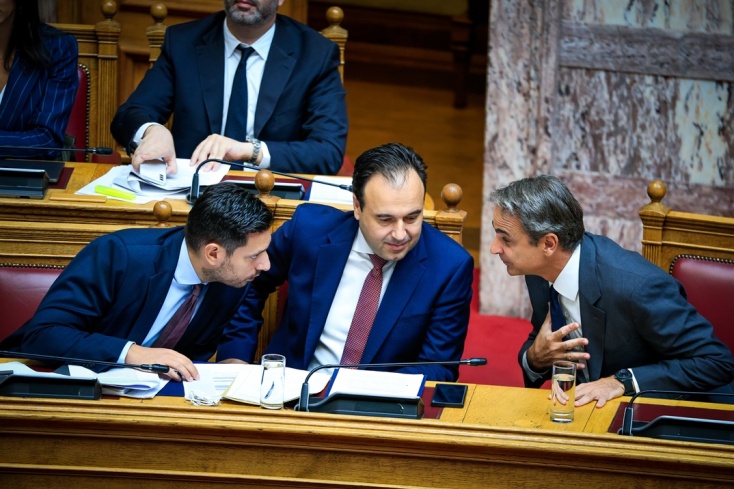
History teaches us that power rarely appears naked. Almost always, it clothes itself in the language of virtue, justice, patriotism, or progress. The duty of both the citizen and the historian is not to be captivated by slogans but to examine whether actions correspond to declarations. It is there that the truth of ideas and the authenticity of values are ultimately revealed.
In today’s Greece, one can no longer even joke. It would be irreverent and unacceptable to utter even the classic phrase “both laughable and tragic.” What is happening and being said in Greece at this moment belongs entirely to the realm of tragedy. And the provocative statement above by the newly elected Secretary of New Democracy encapsulates all the tragedy of our times: the claim that the Right is engaged in a “BATTLE OF IDEAS.”
Ideas are principles and rules established by Nature itself. They are inalienable, immutable, and timeless values. They concern humanity’s most sacred achievements: respect for life, individual freedom, justice, equality, and meritocracy.
Yet these values, as defined above, are the very things one could neither encounter nor expect—even in traces—in a political party led by the son of what many regard as the greatest political opportunist in the country’s history, Konstantinos Mitsotakis. To be inspired by ideas, to fight for values, and to struggle for ideals, one must first rid oneself of the barbaric notions that characterize the so-called liberal camp: “the big fish eats the small fish,” “not all fingers are equal,” “your death is my life.” These notions constitute the primary and fundamental ideological cell of every follower who swears allegiance to the Right. Of course, the same rule applies to the so-called “fake Left.” The names, the titles, the words loaded with populism make no difference.
Contrary to what we said at the beginning—and even at the risk of appearing insensitive to those suffering in contemporary Greece, who are the majority—it is indeed a source of endless laughter to hear a Kyranakis speak of ideas, values, and ideals in the ideological desert represented by the political formation led by Kyriakos Mitsotakis and executed by his new orderly, Kostas Kyranakis. Words automatically lose their meaning depending on who pronounces them and become the exact opposite of their true sense.
In Sophocles’ tragedy Antigone there is a profound verse placed in the mouth of Creon:
“I hate the man who, having committed evil deeds, seeks afterward to glorify them.”
That is precisely what happens when crimes are transformed into “ideas,” as Kyranakis allegedly transforms the crimes of his political master:
- Sending more than 600 desperate migrants, many carrying infants, to the bottom of the sea near Pylos.
- Killing 68 innocent passengers at Tempi because funds intended for railway safety were diverted to political clientele.
- Causing the deaths of thousands during the pandemic while spending billions on Rafale fighter jets instead of equipping hospitals with intensive care units.
- Allowing courts to strip poor borrowers of their homes and hand them over to predatory banking interests.
“FOR GREECE, DAMN IT!—FATHERLAND, RELIGION, FAMILY.” Such is the battle of ideas in the Mitsotakis world of the “blue locust swarm.” If this collection of right-wing followers possesses any ideology, value, principle, or ideal, it is only the stomach: the feast they have enjoyed for seven consecutive years while 80% of Greeks have been impoverished. In everyday language, this amounts to a second bankruptcy—not of the state this time, but of the overwhelming majority of its people.
Homer could not begin the Iliad with anything other than:
“Sing, goddess, the destructive wrath of Achilles, which brought countless sorrows upon the Achaeans.”
What else could he say? That these brave men crossed from distant Greece to plunder wealthy Troy? That their leaders fought over the division of loot and Trojan maidens? The expedition that spread death and destruction throughout their world was presented as a matter of Menelaus’ HONOR and the DUTY of the Greeks. The same story repeats itself today through the voice of a racist, neo-Nazi billionaire who tears his garments because a filmmaker chose a Black woman rather than a white Aryan woman to portray Helen of Troy.
Diotima is therefore invited, with her perspective detached from racism and ideological dogmas, to analyze this great historical phenomenon of all ages: the glorification of crime, the need to dress it in splendid garments such as ideas and values. Yet crime can never truly become an ideal. “The end does not justify the means,” except in the excuses and rationalizations of the perpetrator.
Diotima:
If Diotima were to respond with historical and philosophical detachment, she would probably begin with a basic observation:
The phenomenon described here belongs neither exclusively to the Right nor to the Left, nor to any particular era. It is almost inseparable from politics, power, and human nature itself. No organized system of power presents itself as a vehicle of selfishness, violence, or injustice. On the contrary, every form of power seeks a moral garment. Power requires legitimacy, and legitimacy rarely rests upon naked force alone.
Human beings find it difficult to wage war, kill, oppress, or exploit others while openly declaring, “I do this because it serves my interests.” Instead, they invoke higher values: Nation, God, Freedom, Progress, Revolution, Security, Democracy, or the People. The vocabulary changes; the mechanism remains remarkably constant.
Thucydides had already recognized this during the Peloponnesian War. In his account of the civil strife in Corcyra, he observed how people altered the meanings of words in order to justify their actions. Language itself became an instrument of political expediency. Recklessness was renamed courage, moderation became cowardice, and fanaticism was elevated into virtue.
Sophocles, whom the article invokes, addresses a similar timeless issue. It is not merely wrongdoing that provokes moral disgust; it is also the attempt to beautify and glorify wrongdoing afterward. It is the transformation of injustice into justice and selfishness into duty.
Historical inquiry, however, must preserve an important distinction. It is not enough to label every political act we oppose as criminal. The historian does not begin with conclusions but with evidence. Responsibilities, intentions, consequences, and degrees of involvement must all be examined carefully. Otherwise, one risks committing the same error one condemns: subordinating reality to a predetermined moral narrative.
This may indeed be one of the deepest problems of modern political life. The issue is not that politicians speak about ideas. It is natural for them to do so. The problem begins when ideas cease to serve as standards against which actions are judged and instead become advertising slogans designed to justify those actions.
History is filled with examples. Crusades were fought in the name of God. Colonial empires expanded in the name of civilization. Dictatorships ruled in the name of order. Revolutions were carried out in the name of freedom. Wars were launched in the name of peace. Rarely has power presented itself as it truly was; almost always it has presented itself as it wished to appear.
Thus, the essential question is not whether someone invokes values. The real question is whether their actions confirm the values they invoke.
That is where words are tested. That is where ideas are tested. And that is where it ultimately becomes clear whether we are dealing with genuine principles or mere pretexts. A value is not proven by the slogan that proclaims it but by the cost someone is willing to bear in order to uphold it. When a value costs nothing to the person invoking it, there is always the possibility that it is merely a luxurious garment concealing far more ordinary interests